











Dimond-O History (1925 - 1983)
Dimond-O, the jewel of the Oakland Area Council, served as a Boy Scout summer camp from 1926 until 1978. The camp was located on the north side of the middle fork of the Tuolumne River about 2 miles southwest of the town of Mather at an elevation of 4300 feet. Hetch-Hetchy, the main water supply for the city of San Francisco, was 11 miles to the north and Yosemite Valley was only 25 miles to the south. The land was leased from the United States Forest Service on a special use agreement on January 12, 1926 and was returned to the forest service in 1983.
The history of Dimond-O though actually begins in January of 1922 during a meeting at Camp Dimond in the Oakland hills when Scout Executive Homer Bemiss announces that a Sierra Mountain Camp will be a reality.
The first Mountain Camp of the Oakland Area Council
As early as 1922 the Oakland Council was looking into a location for a mountain camp when Scout Exec Homer Bemiss announced, “The Sierra Mountain Camp will be a reality”. The mountain camp that Bemiss talked about could provide additional camping and hiking opportunities for the older “veteran” scouts of Camp Dimond that could not be provided by the existing camp that was located in the Oakland hills. In July of 1923 the first Sierra Mountain camp was held along the banks of the Truckee River in Tahoe on property owned by Max Taft. This mountain camp was in easy reach of Lake Tahoe, but was only a temporary location while the Council discussed the prospect of a permanent site.
The Land before Dimond-O (The Peach & Fig Growers Associations)
The California Peach Growers Association was a consortium of San Joaquin Valley fruit growers that was headquartered in the town of Fresno. From 1917 until 1925 the California Peach Growers Association, also known as the Peach & Fig Growers Association (CP&FG) operated a sawmill and railway about a mile south of the town of Mather, near Yosemite, as a way to assure a dependable supply of wood shook used for the packing of fresh fruit.
Pivotal to the Peach Growers’ plan was the development of the 69 mile Hetch-Hetchy Railroad that was built to transport construction materials for the building of the O’Shaughnessy dam at Hetch-Hetchy Valley. The Hetch-Hetchy railroad was the only realistic way for the Growers Association to easily move its lumber products from the mountains to the valley. The main line of the Hetch-Hetchy railroad passed within a mile of the eventual Dimond-O campsite. Prior to the Hetch-Hetchy Railroad becoming a common carrier in July of 1918 (meaning that it carried other goods in addition to the Hetch-Hetchy project) the CP&FG began negotiations with the United States Forest Service to cut the government timber around Mather and the Dimond-O site. They also sought approval from private landowners to purchase timberlands or stumpage rights.
Maps from 1918 show that the CP&FG logging camp and buildings were located on a terrace overlooking the middle fork of the Tuolumne river and that the actual sawmill, millpond and mill yard were further up the slope on lands that are still part of the Peach Tree Growers Summer Home Tract. The sawmill began operations in 1918 after the CP&FG secured a logging contract, which called for the harvest of 26 million board feet of lumber with an option for an additional 54 million board feet. At its peak the CP&FG mill and railway provided five or six carloads of lumber a day to the Hetch-Hetchy railroad.
The death of the CP&FG logging operations came in late 1924 when the decision was announced to discontinue the Hetch-Hetchy railroad as a common carrier due to the completion of the O’Shaughnessy dam at the Hetch-Hetchy valley. Probably having gotten prior word, the CP&FG stopped its logging operations in 1924 and the rail lines to the mill and logging camp were removed later that same year. In the summer of 1925 the Peach Growers Association, sold the buildings and equipment to a surplus iron and steel wrecker who began the task of dismantling the mill and adjacent buildings. Another wrecking crew was assigned to dismantle the former logging camp.
DIMOND-O (THE JEWEL OF THE SIERRA’S IS ACQUIRED)
As luck would have it, the cook for the wrecking crew was Jill Aggiullard who had been employed by the Oakland Council at Camp Dimond. Having worked for the scouts for a number of years and knowing their desire to have a mountain camp, Mr. Aggiullard recognized the potential of this particular site. Jill contacted the Oakland Council in October of 1925 to see if there was any interest in using the logging camp as a Boy Scout camp. Reportedly, the Council’s representative was very enthusiastic and quickly sold the idea to the Council.
An investigation into the property was made and at the council board meeting on October 23, Scout Exec Homer Bemiss presented to the board the opportunity to acquire the fully equipped CP&FG logging camp along with its buildings and its inventory of equipment. The consensus of opinion was that this was a desirable “thing” for the council to have and recommended that the camp committee immediately investigate the site further. Only ten days later at the council executive meeting on November 3, 1925, a motion was made by board member George Harris and was unanimously approved to spend $3800 to purchase all of the buildings and equipment that comprised the Peach Growers logging camp and mill area from the United Commercial Company of San Francisco. This included the existing sixty-nine buildings and cabins of the logging camp along with the fully equipped mess hall and its kitchen gear.
The Oakland Council secured a loan from the Bank of Oakland for $3800 with the agreement that it was “to be repaid at the Council’s convenience”. As a homeowner, you’ve got to like those “when-ever” arrangements. A couple months later in January of 1926 the Council sought and received a special use permit from the United States Forest Service for 23 acres to operate a Scout Camp at the former logging camp. The permit called for the Council to lease the land for $400 per year. The length of the original lease is unknown but in 1967 the forest service changed the lease amount from $400 per year to a higher amount until the camp closed. The forest service lease with the Boy Scouts officially expired in 1983.
Dimond-O Is Named
On April 11, 1926 the council officially named the new Boy Scout Camp, “Dimond-O”. The camp’s name is derived from Camp Dimond in the Oakland Hills near Montclair. Camp Dimond was the first permanent camp of the Oakland Area Council and the new Scout camp at the former logging site was to be an outpost of the Oakland Hills camp--hence the name, Dimond-O. The name of “Dimond” itself came from Hugh Dimond who owned the area known as Dimond Canyon in the Oakland Hills and where Camp Dimond was located.
Dimond-O (1954 Camp History as written by Homer Bemiss)
“The first group of young men and leaders to go into the camp was during the Easter vacation of 1926 and were veterans of Camp Dimond. It was a rough weather camp with constant rain. However everyone had a fine time and the rich potentials of Dimond-O were revealed.
The first of two summer camp sessions (each two weeks long) at Dimond-O took place on August 1 at the end of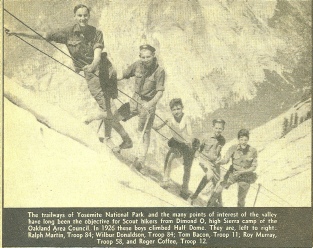 the camping sessions at Dimond. A total of 79 scouts and 22 leaders camped at Dimond-O that first summer. The camp session consisted of hikes to various Yosemite locations including Half Dome, the Pate Valley and Hetch-Hetchy Valley. That first summer the scouts covered no less than 120 miles within the confines of Yosemite Park. The Scouts also dammed up the Tuolumne River, which was adjacent to the camp to create a small swimming hole, and on other occasions hiked over to Mather to swim in Birch Lake.
In the years that followed the acquisition of the camp, it has been necessary for us to remove many of the original buildings that were on the property. These buildings were built to be used by lumbermen and primarily for the housing of single men together with such service areas as a blacksmith shop, oil house, etc. The camp committee has gradually eliminated all of the undesirable buildings and have left standing only those that would be of real service to the camp.
The original buildings were constructed by the lumber company of incense cedar, which has been a very fine thing as the years have shown little effect upon them. The board and batten buildings in the camp are all part of the original setup by the Fig and Peach Growers association.
On the floors of the buildings can be found the evidence of the occupancy of the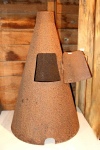 lumberman. The charred areas that are found in the center of many of the buildings are where the old Sibley Stoves were placed on a small earth foundation. These served as the heating facility during the winter logging operations.
You will find throughout the camp many evidences of the former occupancy of the lumber company in the years since 1926. Horseshoes and parts of old metal equipment used by the lumbermen are constantly coming to the surface.
The original campsite included many of the buildings that are now part of the Peach Growers home-site that lies to the north of the camp. Under conditions set forth by the US Forest Service it was necessary for us to relinquish our interest in those buildings. It is not possible to maintain them according to the standards set by the Forest Service. At the present time we have no interest in any of those facilities. Our only interest being in the right of way for the water line that runs through the Peach Growers tract to our 50,000 gallon tank on the hill.
The middle fork of the Tuolumne River affords the scouts the ability for swimming, however it required a dam in order to hold back the creek. From 1926 until 1929 a makeshift dam made from sand bags was used to create a swimming hole. The sacks would remain in place until springtime when a work crew would remove the sacks in time for the spring flood. In October of 1931, the Scouters, including Lew Gardner, built a permanent cement dam across the river to replace the sand bags. The middle of the dam contained wooden slats that allowed the scouts to raise and lower the level of the swimming hole. The swimming area averaged about 6 feet deep but near the dam where a diving platform would eventually be erected, the depth was around 9 feet deep. The water though was always cold from the snowmelt but that did not seem to matter too much to the Scouts that enjoyed the refreshing water.
While the legal boundaries of the camp are designated we have found the Forest Service most cooperative in permitting us to use such additional areas, as our needs require. This also includes the swimming pool (the dam and creek) that is not specifically a part of our camp area yet through all the years of use has been accepted as part of the camp property and has been under our jurisdiction and control. The area across the river up-stream above the camp is designated as the Church of the Wildwood and the area down stream occupied by the Miwok Temporary camping area are not part of our leasehold. We have a verbal agreement with the Forest service to use these areas.
